Showing posts with label ecosal-Atlantis. Show all posts

Tuesday, 20 February 2018

Sel et Salinas

We contributed to a chapter on the archaeology and historical development of salt making in the UK and wrote  the chapter describing salt making sites in the UK that could form the basis of a Salt Route.

Sels et Salines de l'Europe Atlantique


edited by Loic Menanteau

Numerous authors from the partner organisations who participated in the EU funded project Ecosal-Atlantis from Portugal, Spain, France and the UK.
Chapters from the UK by Prof Mark Brisbane, Dr Mark Maltby and Roger Herbert from Bournemouth University; Andrew Fielding from A&A Fielding Ltd, David Cranstone from Cranstone Consulting and Ivan Day from Historic Foods.
500 pages (7 kilos)

Order from University of Rennes University Press


Friday, 17 May 2013

ECOSAL UK Cluster Meetings

We are organising a series of meetings for the UK Ecosal salt network.

Thursday 30 May -
Cheshire, Lancashire, Merseyside cluster
at Middlewich Town Hall 2pm

Wednesday 5 June - 
Welsh cluster
at Halen Mon, Brynsciencyn 2pm

Tuesday 11 June -
Southwest England cluster
at Helston Museum, Cornwall 11am

Friday 14 June -
Southern cluster
at Bournemouth University 2pm

Monday 1 July -
Cumbria, N Ireland and Scotland cluster
at Solway Coast AONB Disovery Centre 2pm

TBC - Sea salt making sites on the east coast
at Heritage Lincolnshire, Heckington
First cluster meeting of the Ecosal-Atlantis - UK Salt network.
Presentation by Andrew Fielding
at Middlewich Town Hall, Cheshire
hosted by Kerry Fletcher, Middlewich Heritage Development Officer
Second cluster meeting of Ecosal-Atlantis - UK Salt Network
Presentation by Andrew Fielding
at Anglesey Sea Salt Company
Brynsciencyn, Anglesey
host by David and Alison Lea-Wilson
The SW Cluster meeting for Ecosal UK
The Southern cluster meeting for Ecosal UK.

Wednesday, 1 May 2013

Salt Network in UK proposed as part of Ecosal-Atlantis Route

The Ecosal-Atlantis leaflet we produced to promote a network of salt sites in the UK.
The printed leaflet was a fold out piece of print which opened up to A1 in size, each topic or regional area can be printed out on an A4 sheet. Download each page from here.
Folder holding all sixteen pdf pages.

Individual pages contained within the folder are:-

SIDE 1
Page 1 - 5 UK Regions and EU Partner Logos
Page 2 - The Atlantic Coast Partners & UK Salt Producers
Page 3 - Different Ways to Evaporate Brine in UK
Page 4 - Open Pan Processes in UK
Page 5 - Materials for Salt Pans
Page 6 - Victorian Salt pans and Rock Salt Mining
Page 7 - The Portuguese Route
Page 8 - The Spanish and French Routes

SIDE 2
Page 1 - The UK Atlantic Coast Route
Page 2 - Scotland
Page 3 - Northern Ireland
Page 4 - Cumbria
Page 5 - Wales
Page 6 - Cheshire, Merseyside & Lancashire
Page 7 - South and Southwest England
Page 8 - Culture and Salt

Friday, 5 April 2013

Animated Ecosal Logo

Shockwave Flash animated Ecosal logo to be posted here. Small file and can run on a loop.
meanwhile here is the link to the Youtube video of the short sequence.


Ecosal-Atlantis Presentations - for a Proposed UK Route and Links to ERIH

Two presentations

Links to be included here.


Monday, 26 November 2012

Ecosal-Atlantis Conference 21-22 November 2012

UK team at the conference centre at Vitoria-Gasteiz, Alava
Roger Herbert, Andrew Fielding, Mark Brisbane, David Cranstone


The Salt Valley at Salinas de Annana.
A major restoration project bidding to become a World Heritage Site.
Salt samples from around the world at the exhibition centre
at Salinas de Annana includes salt from Halen Mon, Wales
A themed sweater for Ecosal-Atlantis, knitted by Annelise Fielding


Tuesday, 6 November 2012

Ecosal-Atlantis Conference 21-22 November 2012

Andrew will be speaking at the final Ecosal-Atlantis Conference in Vitoria, Spain.
21-22 November 2012
He will be making a presentation about
1. The Themed Route for Salt in the European Route of Industrial Heritage  - ERIH
and
2. The proposed salt network suggested as a co-ordinated network for salt sites in the UK
it is proposed that ECOSAL-ATLANTIS can act as the co-ordinator for the salt route in ERIH.
Brian Irving, Manger at the Solway Coast AONB will also be speaking about the role the AONB's can play in developing a salt network as a theme within all coastal AONBs in England, wales, Scotland and N Ireland.
Conference Programme

Saturday, 14 July 2012

Video of Salt Making Demonstration at Newlyn Art Gallery

Finally finished the video made during our Ecosal field trip to Cornwall, where we took part in Newlyn Art Galley's Museum at Night event as part of the Penzance Convention. Share the experience here.


Sunday, 1 July 2012

The SCAPE Trust - Brora and St Monans Salt Works, Fife

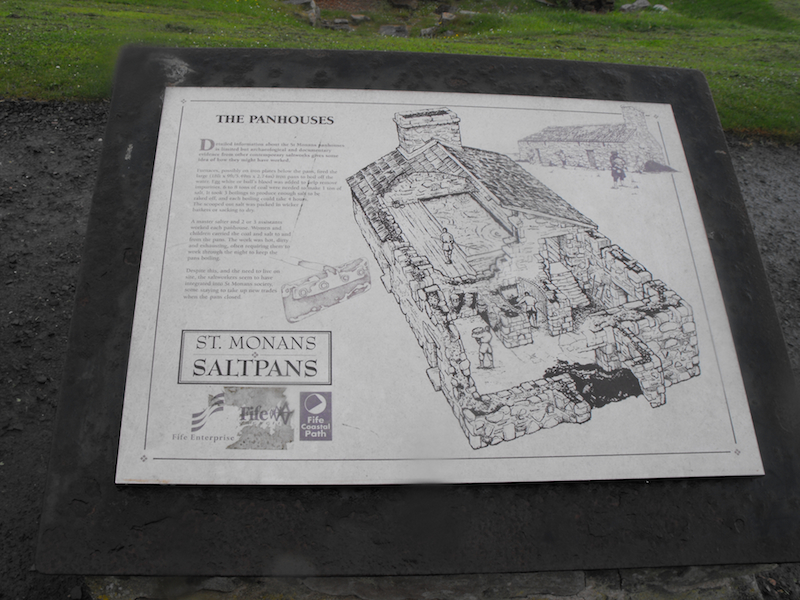
St Monans Salt Works were built in 1771.
We visited this site as part of a visit to St Andrews University to see Tom Dawson and Joanna Hambly of The SCAPE Trust about their participation in ECOSAL-ATLANTIS. 
SCAPE have been involved in the excavation of a salt works at Brora, Sutherland. The project received an award from the Association of Industrial Archaeology for the Best Volunteer Project of 2010.
It is suggested that SCAPE utilise their local contacts and volunteers around the Scottish coastline to coordinate the historic salt making sites of Scotland with the ECOSAL network and Route of Traditional Salt Making.

Not being on the Atlantic coast we can't include St Monans, or the other salt making sites of the Firth of Forth in ECOSAL-ATLANTIS, but as ECOSAL develops from the initial INTERREG funded project we shall look to expand to include sites around the whole of the UK coastline.

The windmill is opened to visitors between July and September.

Paula Martin summarised the history of St Monans - Described by the minister of St Monans in 1790 as 'One of the neatest and best combined salt-works upon the coast', this saltworks was established by Sir John Anstruther, who inherited these lands in 1753. In 1771 (with Robert Fall) he establsihed the Newark Coal and Salt company, integrating a colliery (on the site of Coalfarm, NO50SW 312), a windmill (NO50SW 48), a waggonway and salt pans; these last were built along the shore in 1772-4. Salt was exported through St Monans harbour (NO50SW 81).
The waggonway went out of use in 1794, on account of reduced coal production resulting from a major underground fire. Mining continued on a small scale (apparently to supply the pans) but pumping stopped in 1803; the pans themselves were abandoned by 1823.
Taken together, these remains represent an early intergrated development which has not been obliterated by later works.

Fife Education - Energy Resources
St Monans windmill and salt pans. 

Information panels describing the salt pans, brine tank and windmill.

How the pan houses might have looked.

One of the pan houses has been consolidated.


Remains of a St Monans pan house.
Brine channel drawing sea water to the pan houses.

Barden Mill - Salt Glaze Ceramics for Ecosal

Errington Reay have been making salt glaze pots at Bardon Mill, near Hexham on the A69 since 1878.
Today at Bardon Mill, they are proud of the fact that Errington Reay is the last commercial pottery in Britain licensed to produce salt glaze pottery.
They still practice traditional ways of hand throwing, hand moulding and casting. They grind and mix their own clay and together with specialised salt glazing and firing techniques produce a truly unique textured finish.

Like with the Solway Ceramics Centre, we visited the pottery to see if they would consider participating as a cultural element in the Ecosal Route of Traditional Salt Making. As we have travelled around the west coast of the UK we also visit garden centres and find Errington Reay salt glaze pots for sale all over the country. We think that their pots should feature in the Ecosal route because not only do they produce a fantastic range of pots, but also because they still use traditional processes to make them in their historic mill site.

Karl Jacques shown us around and was really enthusiastic about the company history, the site and the potters who continue the traditional skills.

If you have a choice in a garden centre between these UK made pots or a cheaper import, support our local producers and buy Errington Reay salt glaze pots. They also come with a 10 year guarantee!

Throwing pots from an extruded cylinder of clay.
The Errington Reay stamp before firing and glazing.
Huge range of Errington-Reay pots at the Bardon Mill potery, near Hexham, Northumberland.
The salt kiln.
Karl Jacques.

Solway Ceramics - salt glazing for Ecosal

Ray and Coralin Pearson run the Solway Ceramics Centre. We visited them to introduce them to the Ecosal project to suggest that they might feature as a cultural attraction within the proposed Solway Coast section of the Route of Traditional Salt Making. They were fascinated by the concept and eagerly asked how they might make their own salt from sea water drawn from the Solway, which laps at the fields close to their pottery.
It is possible that we might join them in September to give them a demonstration using ceraaic and metal salt pans. Ray uses wood to fire his salt glaze kilns, has local clay from which he can throw his pots - so he is looking forward to having his own home-made sea salt. Dates to be arranged.

Courtyard setting in front of the tuition and lecture room at Solway Ceramics. 

Ray Pearson in front of his large salt glazing kiln currently being refurbished.

Thursday, 14 June 2012

A Salt Refinery at The Dungeon, Hale, Merseyside

A survey of The Dungeon was carried out by the Merseyside Industrial Archaeology Society

Halton Borough Council are looking at how the site and the surrounding area might be improved as part of perimeter changes around the adjacent John Lennon Airport.

The Dungeon is a rare and important site where rock salt was used to strengthen sea water prior to making white salt. If it surrounding scan be improved it would form an important local recreational site and protect both the industrial and natural heritage. Iain Dignall of Halton Borough Council made an enquiry to us and was delighted to be put in touch with Roy Forshaw and find out that so much information was actually known about the site.

It is probably the best surviving refinery site around, mainly because it didn't become destroyed by later harbour installations. An ideal site for inclusion in the ECOSAL Salt Route, especially if it can benefit from landscape improvements, better access and information panels.

Dungeon Lane forms the boundary between Halton Borough and Liverpool.
Sir Paul McCartney walked down this lane to The Mersey were he would walk and cycle to Hale Lighthouse.
Views across The Mersey towards Frodsham and Helsby, Cheshire.
The cistern for dissolving the rock salt is now covered with a grass mound.
Cheshire rock salt was brought here to strengthen seawater before it was evaporated to make white salt.

Remains of the dock wall where the rock salt was landed.

The bay leading around to Hale Lighthouse

Saturday, 28 April 2012

Ecosal Meeting at Bournemouth

Group photo of a visit to the Waterfront Museum, Poole to meet Clare Randall and look at the museum exhibits. Members of Ecosal visiting were myself, Renato Neves, Portugal; Belen Escobar, Spain;  Benoit Poitevin, France; and Mark Brisbane, Michael Fradley, Bournemouth University.
The team also met with Roger Herbert, ecologist at Bournemouth University who has been working on bio-diversity and habitat surveys of salines as part of the Ecosal research agenda.

Clare Randall, Renato Neves, Belen Escobar, Benoit Poitevin, Mark Brisbane, Michael Fradley
As well as holding business meetings about the development of the Ecosal network the group visited Brownsea Island, Poole Harbour, St Barbes Museum and Lymington salt marshes.

During my flight down to Bournemouth from Manchester the plane flew over salt marshes at the Solent end of the Beaulieu River in Hampshire, and on the return journey over the area known as Ashton and Neumans Flashes at Northwich, Cheshire where rock salt mines collapsed in the nineteenth century and were later infilled with lime waste to create present day habitats for wading birds and is the home of calcarious grassland loving species such as the Dingy Skipper not otherwise to be found in Cheshire.
The Lion Salt Works is in the village of Marston, middle right of the picture on the Trent and Mersey Canal, which can also be seen.

Beaulieu River, looking north. Salt marshes at the mouth of the river where it enters The Solent. 

Ashton and Neumans Flashes, Northwich, looking north west.


Wednesday, 30 November 2011

Creating an Ecosal Route in the UK

Report posted on Bournemouth University Ecosal web site pages.
Creating an Ecosal Route in the UK

Presentation at the Ecosal-Atlantis meeting held at Aveiro, Portugal on 15 November, 2011.
Presentation given to Ecosal meeting

Tuesday, 29 November 2011

Saturday, 26 November 2011

Three Portuguese Salt Sites - part of the Ecosal-Atlantis Route

Spent four days in Portugal at a meeting of the Ecosal-Atlantis project to establish a salt route up the Atlantic coast. One day of site visits covered 200 km south from Aveiro.  More details and web links in next posting
Salina at Aveiro
British Pathe News 1935 - Aveiro salinas

Salina at Figuera da Foz
Nucleo Museologico do Sal

Salina at Rio Maior
Video by Carlos Silva
 

Friday, 17 September 2010

NW Industrial Archaeology Conference 2010

Saturday 25th September I will be participating in the CBA NW Region Industrial Archaeology & History Conference being hosted by the Merseyside Industrial Archaeology Society at the National Waterways Museum, Ellesmere. http://www.mihs.org.uk/CBA.pdf
My talk includes sites that should be included in a new Salt Trail being researched as part of a European funded collaboration called Ecosal-atlantis . After the talk I said  would post a Google map that will include the salt making sites and links I discussed during the talk. This is now included below.

The main objective of the ECOSAL ATLANTIS  project, “Ecotourism in saltworks of the Atlantic: a strategy for integral and sustainable development” is the development of joint, integral and sustainable tourism based on the cultural and natural heritage of traditional Atlantic saltworking sites.
Links between salt making sites have been created in other areas. The ALAS project was established to preserve traditions of salt making in salinas. Work in Portugal and Spain was reported in the conference I organised at Lion Salt Works in 2003 and published in the Lion Salt Works Research Report 'Salt Works and Salinas' in 2005, principally work at Figuera da Foz, Salinas d'Annana and Friends of Inland Salinas.
The Trail may have links to sites featured in the European Route of Industrial Heritage  - ERIH  of which Lion Salt Works was a founder anchor point in the NW of England.
Annelise and I included a gazetteer of the main UK sites in our book 'The Salt Industry' published by Shire Books in 2005.  I have also posted videos of historic salt making experiments on youtube such as a demonstration on Wrangle Marsh, Lincolnshire with Tom Lane and the Heritage Trust for Lincolnshire. Other videos are included under the Saltteller and Saltfriend Channel names.

Revisit for text and google map links. These will be updated over coming days. The map will be enlarged to include all sites with a salt connection.
Click for the Salt Trail Map Link

The standard summary of salt making in Cheshire, written by Calvert and published in 1915 is now available as a download at http://www.archive.org/details/cu31924030692697

Links used in the talk (more to follow)
Cumbria web links
http://www.cumbria-industries.org.uk/salt.htm
http://www.walney-island.com/salt_works_01.htm
http://www.visitcumbria.com/wc/crosscanonby-st-john-the-evangelists-church.htm
http://www.imagesofengland.org.uk/details/default.aspx?id=411241

Wirral Links
http://www.btinternet.com/~m.royden/mrlhp/local/salt/dungeon.htm
http://www.ecosert.org.uk/leaflets/Hilbre.pdf
http://www.deeestuary.co.uk/hilbre/

Cheshire Links
http://www.middlewich-heritage.org.uk/salt-and-canal.html

Salt of the Earth
http://www.saltoftheearth.btik.com/
http://www.flickr.com/groups/saltoftheearth/